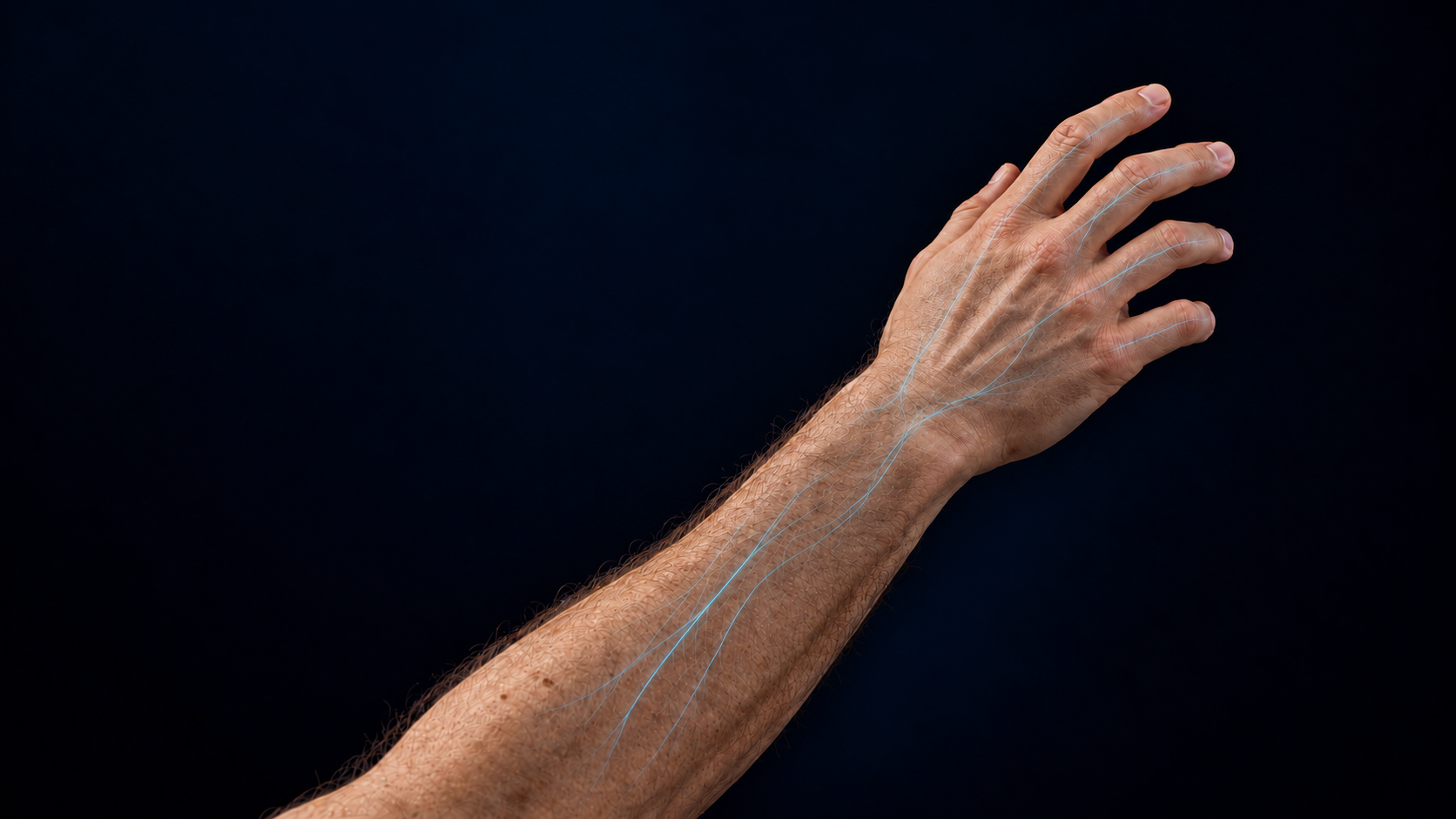
Non-invasive neurorehabilitation platform
Every effort
counts.
Muscle effort becomes interactive practice, so rehabilitation doesn't have to wait for movement. Measurement starts with the first attempt. Starting with stroke recovery.
Integrated device Patient software Clinician tools
The challenge
So much effort.
So little movement.
Muscle activity after stroke (EMG)
Visible hand movement
This signal schematic compares muscle activity measured with EMG and hand movement tracked by a camera. Four bursts of muscle activity accompany four attempts, while visible hand movement remains nearly unchanged.
Recovery after stroke is built on practice. In the early months, the brain is especially responsive to practice that supports relearning movement.12
Yet when opening a hand takes tremendous effort and produces almost no visible movement, there is little feedback to sustain the next attempt and little visible change for a care team to measure.
But the effort is not lost. Even when the hand does not move, the muscle activity behind the attempt can remain.3
Where practice has always waited for movement, VELARC begins with the effort behind it.
Research behind our approach
Research behind our approach
- Zeiler & Krakauer, 2013
A review of heightened plasticity early after stroke and its interaction with rehabilitation training.
- Dromerick et al., 2021 (CPASS)
In this 72-person trial, 20 additional hours of arm-and-hand therapy produced the greatest benefit over standard rehabilitation when started two to three months after stroke, among the periods tested.
- Balasubramanian et al., 2018
Of 30 people with severe chronic stroke and no residual hand or wrist movement, 22 had enough extensor muscle activity for EMG-based detection.
The VELARC platform
Turn muscle effort
into interactive practice.
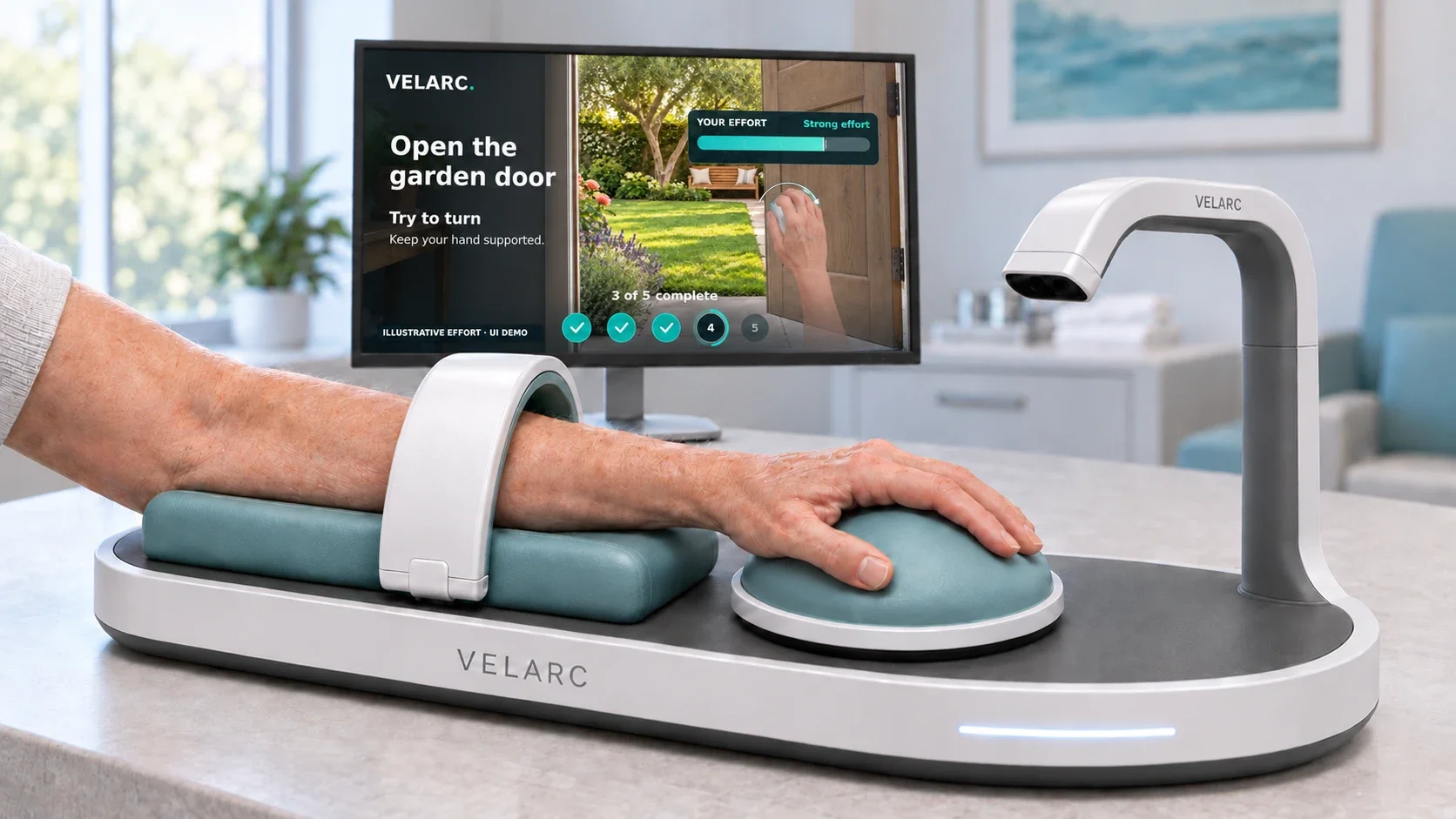
VELARC’s proprietary sensing technology connects muscle activity, force and movement to interactive practice and clinical insight.
01 · Muscle sensing
Muscle effort.
Captured at the forearm.
The AERODOC forearm cradle reads muscle activity while the hand stays free. An attempt becomes an input to practice, even before movement is visible.
02 · Force sensing & practice attachments
Measure force.
Adapt the task.
The hand attachment measures applied force and turning effort. Swap in a key or another practice attachment as the clinician guides progression.
03 · Movement over time
See what changes,
finger by finger.
Compare each finger’s movement with the patient’s starting point and previous sessions. Together with muscle activity and force, these measurements help the care team assess progress and guide the next practice plan.
04 · Practice & clinical review
An on-screen response.
A record to build on.
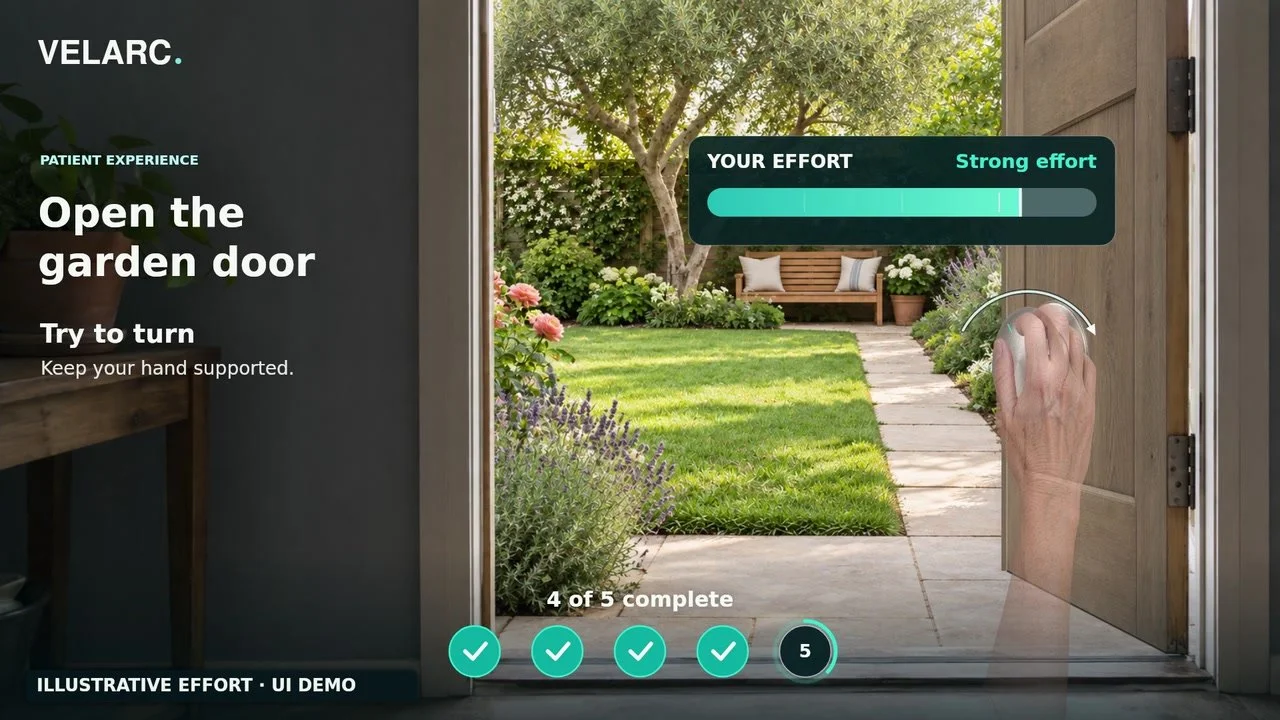
Muscle effort drives interactive practice. Each session becomes a record the care team can review to guide and approve the next practice plan.
Practice the person can see.
Progress the care team can measure.
For clinics and care teams
The controls stay
with the clinician.
VELARC uses each patient’s measurements and practice history to suggest the next practice plan. You review, adjust or replace the suggestion. Only an approved plan reaches the patient.
01 · Caseload
See who needs attention.
Bring active patients, pending reviews and recording concerns into one view.

02 · Review
Review change in context.
Compare measurements across sessions alongside practice history and the patient’s feedback.

03 · Suggested plan
Intelligent planning.
Your clinical decision.
VELARC’s algorithms and machine learning identify patterns across sessions to suggest a personalized practice plan. Review the suggestion, make changes and approve what the patient practices next.

04 · Care team
Keep the care team aligned.
Bring reviewed findings, clinical decisions and the next session together in a care summary.

Clinics & care teams
Help shape VELARC’s clinical development.
Work in upper-limb rehabilitation after stroke? Talk with us about clinical collaboration and future studies.
Explore a clinical partnershipThe recovery arc
Clinic first. Home next.
One platform throughout.
Effort, practice and clinical guidance stay connected as abilities and care settings change. A shared foundation, built to extend beyond its first device.
Clinic · First
Begin with support.
Our starting point is clinic-based practice for people with little or no visible hand movement. A supported setup, guided by the care team.
Home · Planned
Carry practice forward.
Bring the clinician-approved plan into everyday life. Practice, session history and clinical review stay connected across settings.
Across abilities · Planned
Adapt to changing abilities.
As abilities and goals change, practice can adapt through different tasks, attachments and levels of support. The patient’s measurements, practice history and clinician-approved plans stay together across sessions.
One shared foundation
One platform.
Beyond one device.
VELARC connects sensing, patient practice and clinical planning through shared measurements and practice history. The software is designed to carry that continuity across care settings and compatible devices as the platform develops.
Future connections
Connect more devices.
A path toward connecting future VELARC products and compatible devices from other makers.
Future applications
Stroke is the starting point.
Exploring other neurological conditions affecting the hand and arm, with research specific to each condition.
- Traumatic brain injury
- Cerebral palsy
- Parkinson’s disease
Different abilities. Different conditions. Different care settings.
One connected platform.
Home use, additional device connections and new conditions describe future development.
The people behind VELARC
Medical-device builders.
Stroke clinicians.
Engineering, biosignal science and rehabilitation expertise, working together around the patient’s experience.

Leadership
Anwaar Spence
Founder & CEO
Medtech and digital-health executive. Former BrightInsight director and J&J MedTech strategic advisor; led Medtronic’s neurovascular M&A integration.
LinkedIn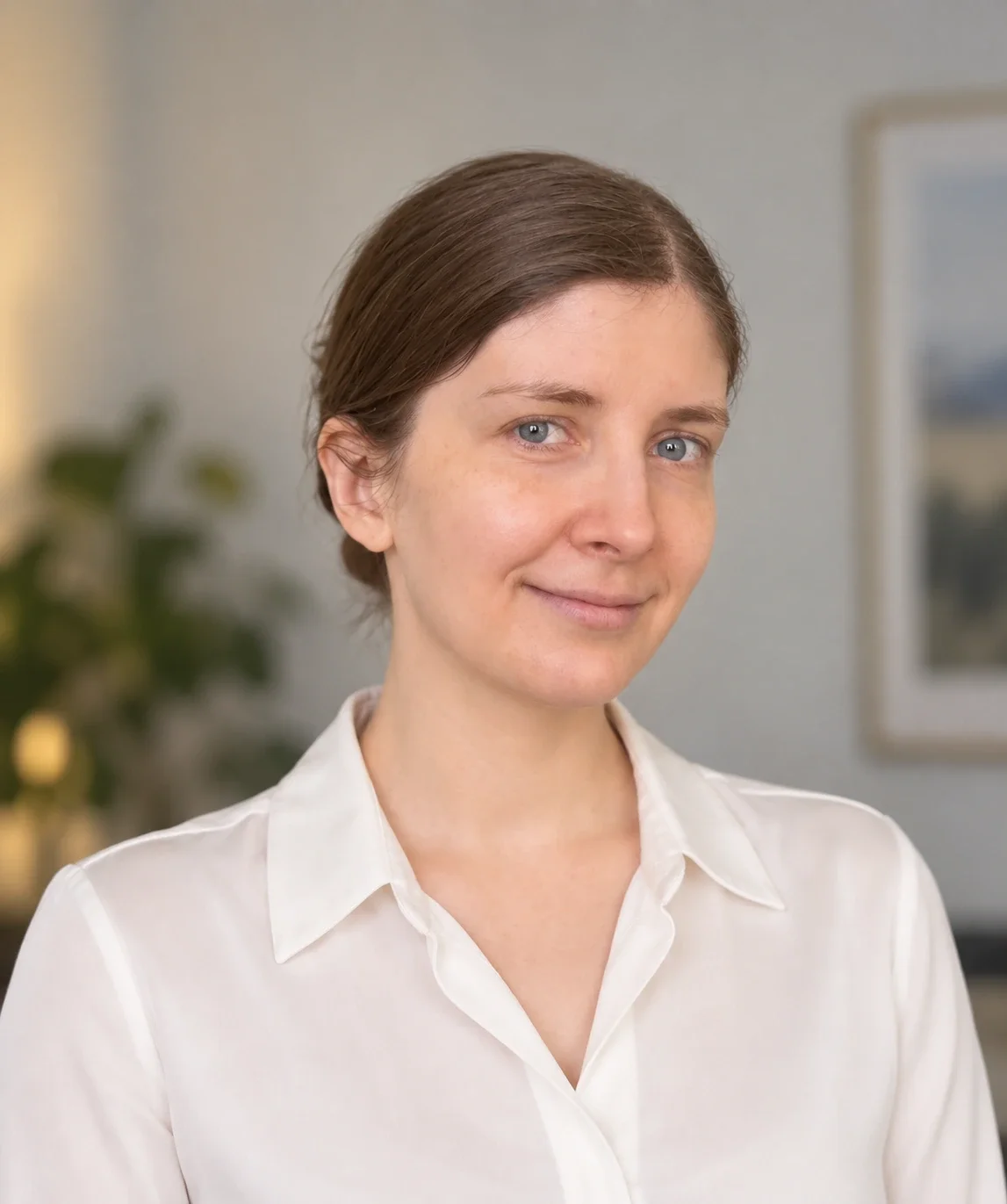
Software & biosignals
Anya Stetsenko, PhD
Software & Data Acquisition Lead
Neuroscience and biosignal analytics, from muscle signals to patient software.
LinkedIn
Device engineering
Richie Daru, PhD
Mechanical & Electrical Engineering Lead
Wearable biosensing hardware and medical-device engineering.
LinkedIn
Study operations
Ben Korte, PhD
Study Operations
Research protocols, study visits and data coordination.
LinkedIn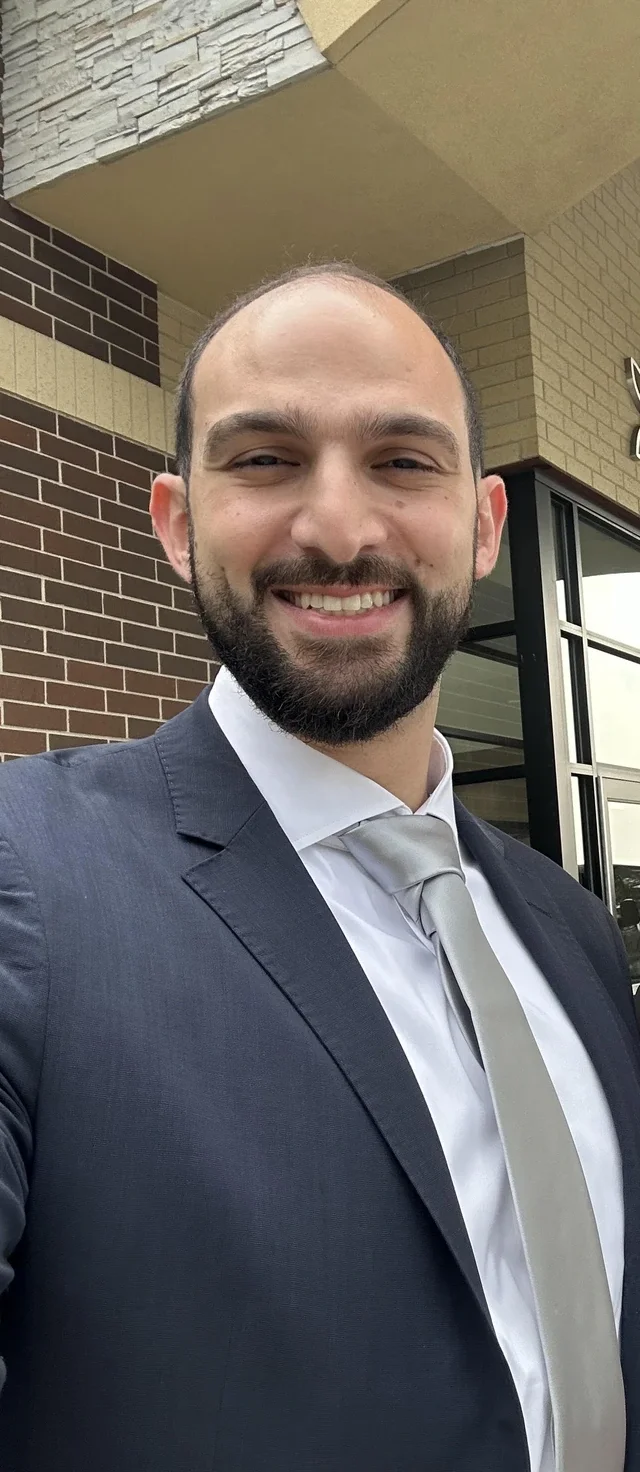
Systems integration
Thaer Alafghani
Principal Systems Engineer
Sensors, neurostimulation and medical-device systems integration.
LinkedInClinical & specialist advisors


Get in touch
A new arc.
Built together.
Whether you guide care, build technology, back early companies or are navigating recovery, we’d like to hear from you.
Clinicians & researchers
Treat upper-limb impairment after stroke? Connect with us about clinical collaboration and future studies.
Explore a clinical partnershipInvestors
Learn about our team, development plans and the platform’s potential beyond its first device.
Request an introductionBuild with us
Bring your expertise in biosignals, machine learning, software or medical-device engineering. Tell us what you would bring to VELARC.
Introduce yourselfPatients & families
VELARC is not yet available for patient care. For news about future availability, send us a note.
Ask about future availability